Roses & Lace Styling

Roses & Lace Styling

Facebooktwitterpinterestlinkedinmail

Roses & Lace Styling

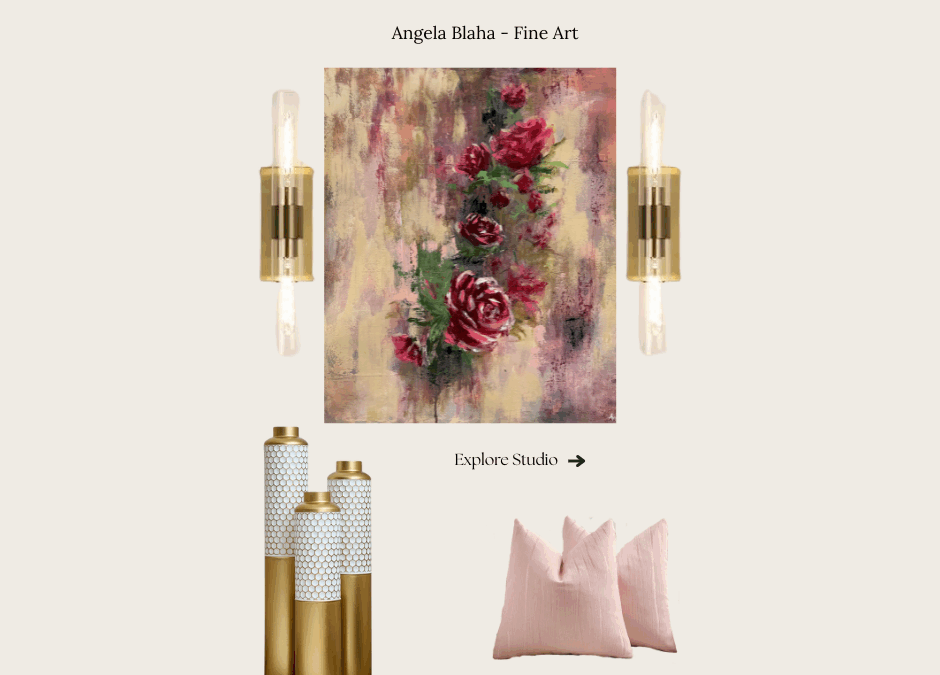
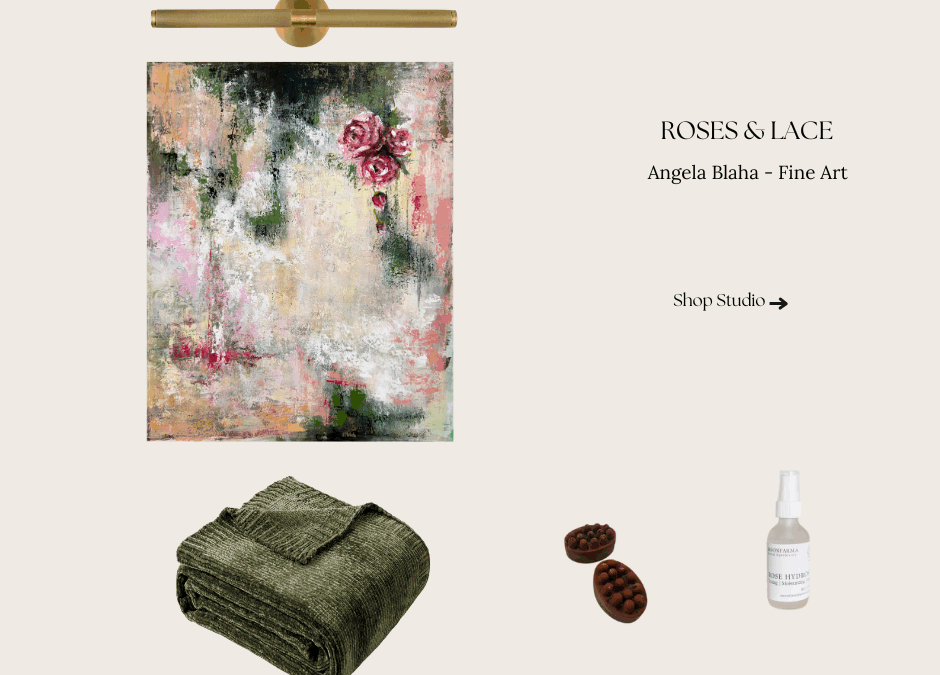
There’s a quiet indulgence in Roses & Lace—the kind of luxury that doesn’t need to announce itself, because it’s felt the moment you step into the room. The blush tones soften your edges, the deep greens ground your breath, and the textured layers whisper of elegance woven through time. This piece invites you to feel luxurious not because of material excess, but because you’re allowing beauty to shift your inner state. With Roses & Lace, luxury becomes an energy you inhabit—an intimate reminder that refinement, softness, and depth are not things you acquire, but frequencies you choose to live in.

When you bring Roses & Lace into your home, you’re choosing more than art.

You’re choosing an atmosphere—one that elevates how you move, breathe, and feel in your space. This painting becomes a quiet companion that softens your mornings and enriches your evenings, infusing the room with warmth, grace, and a sense of being held. It creates a sanctuary where your nervous system can settle and your heart can expand. In its presence, you don’t just decorate—you cultivate a space that mirrors the level of beauty and inner richness you’re ready to step into.

Knurldon Gold Brass Hardwired Picture Light

Soap Massage Bars by Moonfarma

Facial Hydrosol | Toner by Moonfarma

BATTILO HOME Olive Green Chenille Throw

The Color Codes

The Color Codes

Facebooktwitterpinterestlinkedinmail

Color is the oldest language.

An article as seen on Creativity Portal.com

There is something deeply stirring in me when the sun begins to set and the sky burns with yellow, orange, gold and purple. To most, that moment whispers of endings. To me, it feels like an awakening.

As the light shifts, love floods through me. My breath slows, and my gaze grows intent — as if my soul is trying to drink the color before it disappears. I used to think it was nostalgia. Now I know it’s something far older: the body remembering the language of color. 

Before we ever learned to speak, we saw. Color is the oldest language — a primal conversation between light and the nervous system. It bypasses logic and speaks directly to the subconscious, shaping how we feel, act, and perceive the world. Psychologists call it affective color processing: hues travel from the retina to the emotional centers of the brain before reason can interpret what’s happening. That’s why we feel color before we think about it. Red doesn’t symbolize vitality — it activates it. Blue doesn’t represent calm — it induces it.

Color is emotion made visible.

We are drawn to certain colors because they bypass logic and speak directly to the subconscious. Yellow pulls us when we’re ready to expand into clarity and confidence. Orange calls when creativity and connection want to rise. Red finds us when passion and power are ready to return to the body. And blue — that sacred hue of infinite sky — holds the frequency of truth and surrender. Our attraction to color isn’t preference. It’s resonance. The frequencies we’re drawn to reveal the energies our system is trying to integrate. We don’t choose color — it chooses us, guiding us toward balance and wholeness.

Modern psychology has shown that color can alter our physiology within seconds. Red light increases heart rate and focus; soft blues slow the pulse and invite reflection. Even subtle changes in hue shift the way we perceive time, safety, and possibility. Yet beyond science lies something far deeper — the mystery of how color awakens emotion and memory we didn’t know we still carried. We’re not reacting to pigment; we’re responding to coded light that reorganizes the psyche. Every hue is a frequency that interacts with our inner architecture, reminding us of what we’ve forgotten to feel.

Perhaps color isn’t decoration but revelation — consciousness expressed through wavelength. When the sky burns with orange and red, it’s not the end of the day; it’s your subconscious remembering itself in light. So the next time a color captures you — when you can’t look away, when something in you stirs — pause. Listen. It may not be the beauty you’re seeing, but something deeper. 🖌

Art as an act of time travel

Art as an act of time travel

Facebooktwitterpinterestlinkedinmail

An article as seen on Creativity Portal.com

We usually think of art as something that hangs on a wall, rests on a pedestal, or plays through our headphones. But art is not fixed. It is alive. It moves, bends, and opens time in ways we rarely pause to notice.

I was reminded of this when my brother saw one of my paintings — a bridge awash in golden light. He grew quiet and told me about his near-death experience years ago. In that threshold moment, he too saw a luminous crossing, a place between worlds. My painting didn’t just remind him — it transported him. In an instant, he was back there, standing inside memory and mystery.

This is what art can do. It doesn’t just represent; it reactivates. It gathers the past, present, and future into a single moment and hands it back to us.

When art speaks across time

Every creative act carries an imprint of the moment it was born. A brushstroke holds the energy of a heartbeat; a phrase carries the breath of the one who wrote it. When another person encounters the work, it is as if they touch that moment directly.

That’s why ancient cave paintings still pulse with power. They are not relics but transmissions. The handprint of a human from 20,000 years ago still whispers: I was here. And now you are too.

When we truly listen, we hear more than the image — we hear our own soul stirred awake. A memory, a longing, or even a glimpse of the future is called forward.

The living dialogue

Art as time travel isn’t passive. It asks us to participate, to notice what is being stirred and to let it shape us. My brother could have dismissed his memory as coincidence. Instead, he leaned in. He listened. And in that listening, the painting became more than an image — it became a bridge that connected his life then and his life now.

This is the deeper invitation of art: to treat each encounter as a conversation. Not just “I like this” or “I don’t.” But What is this showing me? Why did it arrive now? What is it asking of me?

When we listen at that level, art becomes a guide. It reminds us of what we’ve forgotten, or it shows us what we’re becoming. Sometimes it returns us to an old wound, so we can finally see it with new eyes. Sometimes it lifts us into a vision of who we could be.

The shift in perspective

What would change if we began to approach art this way—not as something to consume, but as something to commune with? We might discover that every encounter with creativity is a moment of time travel. A chance to remember, to reimagine, to realign.

And maybe that’s the real gift: art isn’t here to decorate our lives. It’s here to stretch them. To collapse time until all that remains is the truth we most need to see. 🖌


The Myth of the Lightning Bolt

The Myth of the Lightning Bolt

Facebooktwitterpinterestlinkedinmail

What real creative revelation looks like.

An article as seen on Creativity Portal.com

We’ve all heard the stories — the poet who scribbled a masterpiece in a frenzy at 2 am, the painter who saw a vision in a dream and painted through the night, the lightning bolt of inspiration that split the sky and changed everything.

But let me ask you: has that ever really been the full truth of your creative process?

For years, I believed that was how it was supposed to happen. I waited for the surge, the divine flash, the unmistakable knowing that this was the thing I had to make. And yes, sometimes there are sparks like that — beautiful, electrifying moments. But more often than not, my art speaks in whispers, not thunder.

It stirs quietly. A shape forms in my mind before I ever sketch it. A phrase repeats like an echo I can’t quite place. Most times I begin creating without knowing why — and only after the piece is complete do I understand the message it carried.

That’s not a lightning bolt. That’s something slower, deeper, more intimate.

And yet we’re conditioned to believe that if inspiration doesn’t come loud and fast, it’s not real. We chase the high of revelation. We wait until we feel worthy or certain. We tell ourselves that if the muse isn’t shouting, we must not be ready.

But what if the muse is whispering, and we’ve simply forgotten how to listen?

Waiting for the lightning bolt can become a form of avoidance. It’s seductive. It lets us stay still, safe, uninvolved. But creativity, real creativity — the kind that changes you — requires a relationship. A willingness to lean in even when the path isn’t clear. A trust that what you’re being shown, however faint, is enough.

Some of the most potent work I’ve created didn’t start with a vision. It started with a feeling I couldn’t name. With an image that made no sense. With a longing that I followed into form. Like my current fascination with structures on a beach.

We don’t always need to know what we’re creating to begin.

That is the myth we must undo — that creation begins with clarity. Often, clarity comes after. It’s the residue of devotion.

If your muse has been quiet lately, maybe she’s not absent. Maybe she’s just speaking in a softer tone or a different frequency. Maybe she’s waiting for you to drop in closer. To breathe. To put your hands on the canvas, the keys, the page — not to perform, but to remember.

You are the conduit. The current flows when you show up. It’s often okay to push through and just paint without knowing exactly what it is you are painting.

We are not here to be struck by lightning. We are here to be the lightning — alive, electric, embodied.

So stop waiting for the flash.

Create anyway.

The spark lives in you. 🖌


Where the edge lives

Where the edge lives

Facebooktwitterpinterestlinkedinmail

More than just being creative.

An article as seen on Creativity Portal.com

Let me tell you something that no one likes to admit:

The edge is where the real ones live.

Not the imitators. Not the safe players. Not the ones waiting for validation before they dare speak.

The edge is where vision is born. And it’s not romantic. It’s not neat. It’s not a well-lit studio with mood boards and playlists.

It’s a thunderstorm inside your chest.

It’s a knowing that claws at your insides until you either create or crack.

It’s standing at the border of the known world, staring into what hasn’t been named yet — and having the audacity to translate the void.

Creation doesn’t happen in the comfortable middle. The Universe doesn’t whisper secrets to the ones numbed by trends or chasing applause. No.

The sacred transmissions come to those who are willing to stand alone, wide-eyed, listening for what’s coming before it arrives.

This is about more than just being creative.

This is about being a vessel for the Divine frequency.

Raw. Electric. Uncompromising.

When you create from the edge, you’re not painting a pretty picture or writing a clever line.

You’re opening portals. You’re making the invisible visible. You’re letting the soul of the Universe speak through your hands, your breath, your brush, your body.

And yes, it costs something.

The edge is not for the faint-hearted.

It requires sacrifice. Not of your art — but of your illusions.

You must give up fitting in.

You must release the need to be understood before your time.

You must be willing to go first — before the world is ready.

Because the world is never ready for the real ones.

But that doesn’t matter.

You weren’t made for the world as it is.

You were made to remake it.

So if you feel like you don’t belong… good.

If you feel like you’re standing at the brink of something massive and unnamed… perfect.

If the energy coursing through you feels too big to hold… then you’re exactly where you need to be.

This is the edge.

This is where art meets soul, where soul meets cosmos, and where you become a living current of creation itself.

Now — what are you going to do with it? 🖌